
Bracelet size is a measurement of the bracelet itself, usually its finished length or inner circumference, while wrist size is the circumference of your wrist; the two are measured differently. A flexible bracelet’s finished length is usually longer than its intended wrist circumference; rigid bracelets need their own inside dimensions and entry-opening checks. Measure your own wrist first, then check whether a listing gives wrist circumference, finished length or inner diameter, and whether the design is adjustable. Reynborg sizes its bracelets at 18.5, 20, 22 and 24 cm including the clasp (Small, Large, XL and 2XL) and recommends each for wrists at least 2 cm smaller, from up to 16.5 cm for Small to 20.1–22 cm for 2XL; other makers’ charts can differ.
Key facts
- An inch is exactly 25.4 mm, so 1 inch equals 2.54 cm, as NIST’s length-unit guidance confirms (see the bracelet size chart in cm and inches).
- An 8-inch bracelet label equals exactly 20.32 cm under NIST’s definition of the inch (see whether 8 inches is the standard men’s size).
- The U.S. Army’s ANSUR II survey of 2010–2012 reported a mean male wrist circumference of 17.59 cm (6.93 inches) across 4,082 male personnel, a reference for one measured group rather than all men (see average male wrist size).
- In that ANSUR II sample, the 5th percentile wrist circumference was 16.2 cm (6.38 inches) and the 95th percentile 19.1 cm (7.52 inches) (see why your own wrist measurement matters).
Start here
- How to measure your wrist for a bracelet — Measure your wrist with a flexible tape or a marked paper strip, then follow the bracelet maker’s size chart. Learn how to keep fit allowance separate, check a printable sizer, verify phone estimates and account for closed bangles.
- How should a men's bracelet fit? — A good bracelet fit feels comfortable, stays secure and lets your wrist move. Compare close, regular and relaxed preferences, then check the fastening, construction and maker’s size chart before deciding whether your bracelet fits.
- Men’s bracelet sizes in cm and inches: a conversion chart — Convert bracelet measurements between centimeters and inches with a checked reference chart and worked examples. Learn how to distinguish wrist size from bracelet dimensions, preserve readings near size boundaries and interpret a maker’s S, M and L labels.
On this page: Measure the wrist you will use · Check the design's sizing system · Comfort comes before an average · Buying for someone else · Explore the guides · Measurements and size labels · Comfort and fit · Width and proportions · Stretching, resizing and wrist changes · Keep exploring
See the wider collection of sizing, adjustment and comfort guides. Open the Sizing and fit collection for related guides from other topics.
Measure the wrist you will use
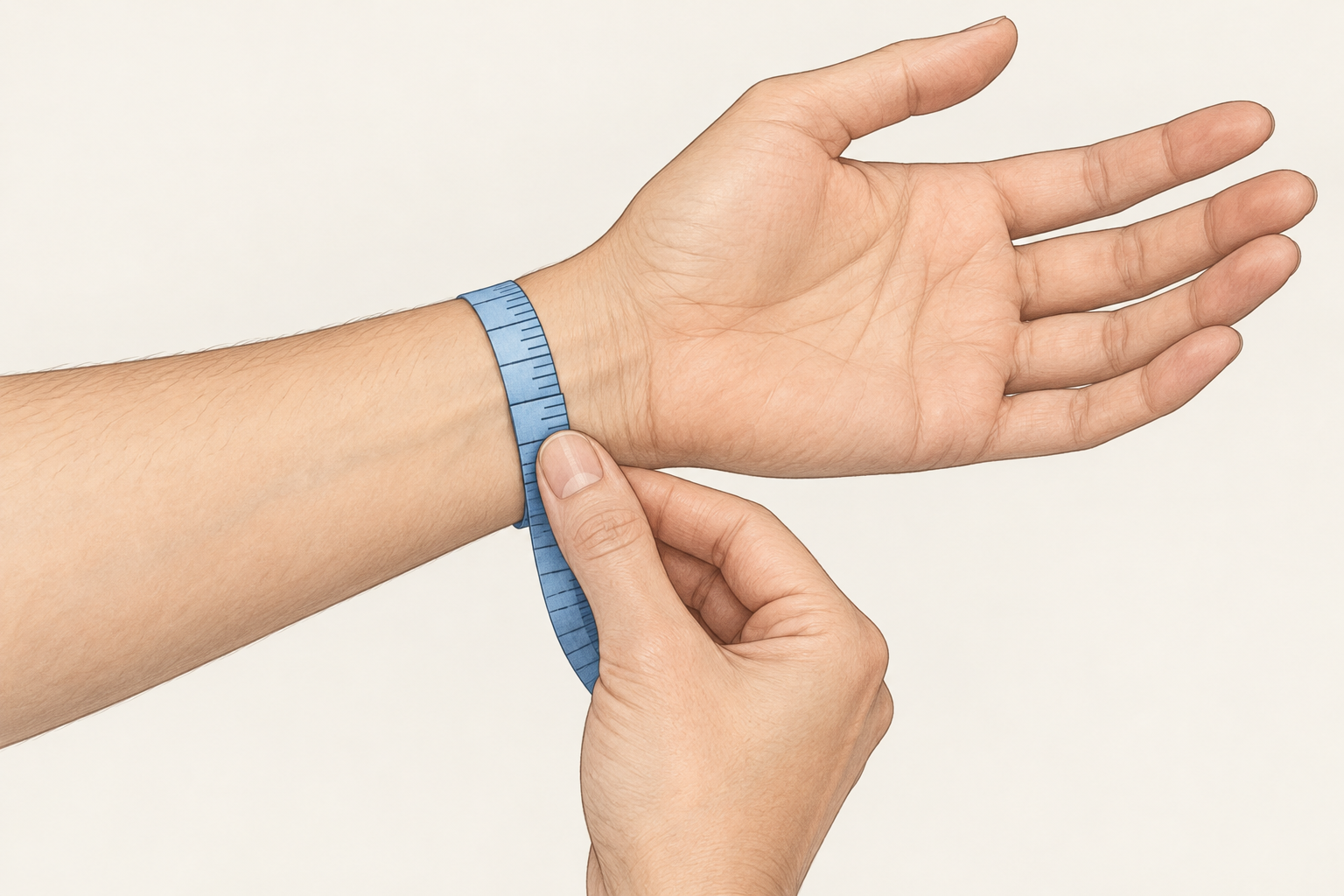
Use a flexible tape, or wrap a narrow strip of paper around your wrist and measure the marked length with a ruler. Keep the tape in contact with the skin without pulling it tight. Measure where you expect the bracelet to sit, and repeat the measurement if the first result looks uncertain.
Write down the actual measurement rather than choosing a letter size from memory. Small, medium and large are seller labels, not universal standards. Inches and centimeters can be converted accurately, but a number does not become a reliable product size until you know what the seller measured.
Check the design’s sizing system
A straight chain measured from end to end does not fit exactly like a thick beaded loop with the same stated length. A closed, slip-on bangle needs to pass over your hand. A cuff has an opening and shape as well as an overall circumference. A wrap bracelet takes more than one turn around the wrist. Treat each construction as its own sizing problem.
Ask the seller whether the chart refers to your wrist or to the finished bracelet. If the chart already includes a comfort allowance, adding another allowance can create an unexpectedly loose fit. When a listing gives only a length, ask how the maker intends you to compare it with your measurement.
Comfort comes before an average
A population average does not tell you which bracelet to order. People with similar wrist measurements can prefer different movement, widths and bead sizes. A watch worn alongside the bracelet changes the available space. Try moving your wrist, sliding a sleeve over the clasp and resting your hand on a desk.
The bracelet should not pinch, restrict movement or make your skin sore. A little movement may be comfortable; repeated slipping over the hand is a different problem. If a piece leaves persistent pressure marks or becomes uncomfortable, take it off and revisit the fit rather than waiting for it to stretch.
Buying for someone else
The most reliable option is asking for a measurement. If the gift is a surprise, compare a bracelet the person already wears, with permission where appropriate, and find out how its length was measured. Adjustable designs or clear exchange terms can reduce the consequences of guessing, but they do not guarantee a fit.
The guides below cover measuring, conversion, small and large wrists, beads, clasp differences, resizing and gifts. For help deciding which construction suits your needs, see bracelet types. If an existing bracelet is causing trouble, browse problems and fixes.
Explore the guides
Measurements and size labels
- How to measure your wrist for a bracelet — Measure your wrist with a flexible tape or a marked paper strip, then follow the bracelet maker’s size chart. Learn how to keep fit allowance separate, check a printable sizer, verify phone estimates and account for closed bangles.
- Men’s bracelet sizes in cm and inches: a conversion chart — Convert bracelet measurements between centimeters and inches with a checked reference chart and worked examples. Learn how to distinguish wrist size from bracelet dimensions, preserve readings near size boundaries and interpret a maker’s S, M and L labels.
- Average male wrist size: why your own measurement matters — A measured wrist-size average offers context, but your own circumference determines bracelet fit. Understand the limits of military and country comparisons, separate wrist size from finished bracelet length, and use the maker’s measurement instructions before choosing a size.
- Bracelet length vs wrist circumference: why they differ — Wrist circumference, finished bracelet length and the opening inside a closed bracelet describe different measurements. Learn how thickness, beads and clasps change the comparison, and how to read a maker’s size label before choosing a size.
- How to find a man's wrist size without asking him — Keep a bracelet gift a surprise using information already shared or an owned bracelet measured with permission. Learn which sizing clues deserve confidence, what adjustable ranges really mean and when to wait before engraving.
- How to measure a bracelet you already own — Measure an existing bracelet by its construction: open length for a flexible piece, inside dimensions for a rigid bangle, and relaxed inner fit for beads. Record the clasp setting and units so you can compare the result correctly.
- Is 8 inches the standard men's bracelet size? — An 8-inch bracelet is not an automatic fit for every man. Learn what the size label describes, why maker charts differ, how clasps and beads affect fit, and what to check before buying it for yourself or as a gift.
- Who fits a 7.5-inch bracelet? — A 7.5-inch label does not identify a universal wrist size. Check what the measurement describes, how the clasp and construction affect usable room, and whether the bracelet will fit comfortably and pass over the hand before buying or gifting it.
- XL and XXL bracelets for men: sizes above 8.5 inches — Shop for XL and XXL bracelets by wrist range, usable maximum and exact-model availability, then confirm the measurements and terms of a longer order.
Comfort and fit
- How should a men's bracelet fit? — A good bracelet fit feels comfortable, stays secure and lets your wrist move. Compare close, regular and relaxed preferences, then check the fastening, construction and maker’s size chart before deciding whether your bracelet fits.
- Bead size for men: 6, 8 or 10 mm? — Compare 6, 8 and 10 mm round beads by their visible size, side profile and sleeve clearance. Use three written outfit examples to choose the look you want, then check the finished bracelet’s wrist fit separately.
- Between two sizes: which one to take? — Choose between two bracelet sizes by checking what the maker’s chart measures, its guidance at boundaries and your preferred movement. Compare instructions for beads, rigid bangles, adjustable designs and chains, with two imagined sizing examples.
- Fit and clasp type: why a screw clasp fits differently from a magnet — A clasp changes more than how a bracelet closes. Compare the engaged length, end overlap, rigid housing and room needed to operate a screw or magnetic closure before choosing a size for your wrist.
- Fit for a beaded bracelet: elastic vs cord — Elastic, a fixed clasp and a sliding cord closure solve different fitting problems. Learn to check a beaded bracelet’s resting size, entry opening and usable inner space, including how beads, knots and charms affect comfort.
- Sizing a bracelet to wear next to a watch — Measure the bare-arm position your bracelet will occupy beside your watch, then use the exact design’s size chart. Compare placement, construction and clasp operation, and check the pair with your usual sleeve before choosing a size.
Width and proportions
- Bracelet proportions with a large watch — Pair a large watch with a quiet, low-profile bracelet, or give a bold bracelet its own wrist. Compare case height, lug extent and band width, then check sleeves, wrist movement and access to the watch controls.
- Bracelets for big wrists — Find a bracelet that fits a larger wrist by checking usable circumference, the maker’s size range and the closure. Compare chains, beads, adjustable cords and bangles, then confirm extended sizes and return terms before buying.
- Bracelets for muscular forearms — Choose a bracelet for muscular forearms by its wear position, forearm taper and construction. Compare chains, straps and cuffs, measure higher pieces separately when stacking, and check the closure through everyday hand movements before deciding on visual weight.
- Bracelets for small wrists — Find bracelets that fit a small wrist by checking the minimum adjustment, size-chart meaning and closure. Compare cords, chains, beads and cuffs, consider professional shortening, and keep the quiet or bold look you enjoy.
- Bracelets for thin wrists: how to avoid the borrowed look — Choose a bracelet that fits comfortably, then compare its outline, closure and position with your usual clothes. Three simple outfit examples show how changing one detail can make a bold or quiet piece feel more intentional.
- How thick should a men's bracelet be? — Choose bracelet thickness by its side profile, sleeve clearance and comfort against a desk. Compare the whole design, including clasps, knots and raised details, and learn why width or a single millimeter label cannot describe its bulk.
- How wide should a men's bracelet be? — Compare bracelet widths from 4 mm to 15 mm and separate the visible band from loop fit. Use practical proportion comparisons to decide whether to change width, clasp, profile or the space beside a watch and sleeve.
- One-size bracelets: who they fit and who they do not — One size means one option, not a universal fit. Compare minimum and maximum wearing settings, hand-entry clearance and rigid details to see whether a fixed bangle, cuff, elastic bracelet or adjustable design will suit you.
Stretching, resizing and wrist changes
- Can a bracelet be resized? — Some bracelets can be resized, but the method depends on their construction. Learn what to ask about chain links, beads, cord, leather and rigid designs, and what to confirm before approving a permanent change.
- Do cord bracelets stretch? — Cord bracelets can change fit through elastic stretch, settling construction or a moving closure. Learn how to check your bracelet’s relaxed loop, adjustment and wrist measurement, and when to ask its maker for help with a loose or damaged cord.
- Do leather bracelets stretch or shrink? — Leather bracelets may stretch or relax, but softness does not prove extra length. Learn how to compare your bracelet without pulling it, check its closure, handle accidental moisture and choose a comfortable size without relying on break-in.
- Do wrists get bigger with age, training or weight? — Wrist size can change, but age, height, training and body weight cannot predict your next bracelet size. Learn how growth differs from adult fit changes, what summer and exercise swelling mean for fit, and when to remeasure.
- Sizing a bracelet for a growing teenager — Measure a teenager’s wrist now and choose adjustment that fits today while allowing a later size change. Learn what to check in sliders, extension chains and removable links, and when to revisit the fit.
Keep exploring
Compare the options in Buying guides, recognize designs in Bracelet types, or browse every topic.