
Bracelet types are named by construction, shape or chain pattern: the broad families are chain, cord, leather, beads, cuff and bangle, and narrower names such as curb or Figaro identify a particular chain. Knowing the right name helps you ask about fit, closure, material and care, and the bracelet glossary defines the terms you will meet in listings.
Key facts
- Collins defines a bracelet as an ornamental band or chain worn around the wrist or arm (see what a men’s bracelet is called).
- A bangle is a rigid, ring-shaped bracelet that slips over the hand, and the Collins American English definition also includes hinged versions with a clasp (see bracelet vs bangle vs cuff).
- A cuff is usually C-shaped, with an opening between its ends that lets it onto the wrist, as the Jewelers of America bracelet guide describes it (see how a cuff differs from a bangle).
- A curb chain has interlocking links of uniform size that lie flat and close together, according to the Jewelers of America chain guide (see curb chain bracelets).
- A Figaro chain repeats a change in link length; MJSA’s Chain Glossary describes both a three-short, one-long sequence and a one-short, one-long sequence (see Figaro chain bracelets).
Start here
- Types of men's bracelets: an illustrated overview — Use an illustrated reference to recognize bangles, cuffs, chains, straps, cords and beaded bracelets. Follow the construction around the wrist, separate the band from its closure, and find the detailed guide for the form you want to understand.
- Bracelet vs bangle vs cuff: the difference — A bangle and a cuff are both bracelets. Understand the difference between a closed rigid loop, an opening bangle and an open cuff, with practical examples that make overlapping shopping labels easier to read.
- Chain bracelet types explained: curb, Cuban, Figaro, box, rope, wheat, snake, Byzantine, Franco — Learn to recognize cable, curb, Cuban, Figaro, box, rope, wheat, snake, Byzantine and Franco bracelet patterns. Compare their visible structure, then check the actual dimensions, movement and fastening before choosing a particular chain.
On this page: Recognize the main families · Chain names and decorative variations · Names do not choose the wearer · Use the glossary for a purchase · Explore the guides · Understanding the names · Bangles and cuffs · Chains and linked designs · Cord, textile and wrap designs · Identity and medical information · Keep exploring
Look beyond the bracelet name to the fastening you will use. Open the Clasps and closures collection for related guides from other topics.
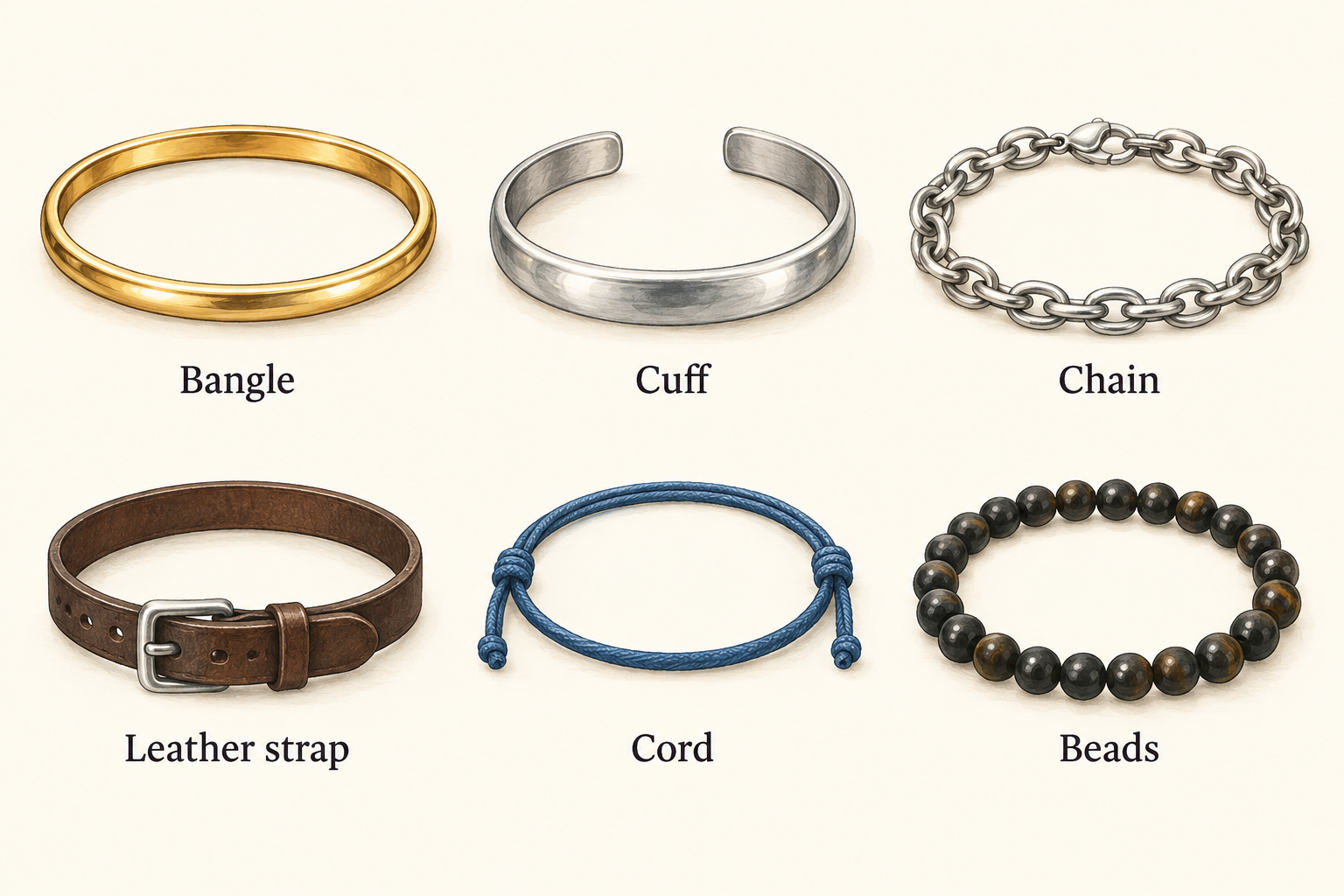
Recognize the main families
| Family | What to look for | The fit question |
|---|---|---|
| Chain | A linked metal construction with a closure | How is the finished length measured? |
| Cord or woven textile | Fiber, braid or weave, knot and clasp | What is the usable adjustment range? |
| Leather | Flat strap, rounded cord, braid or wrap | Does the chart describe wrist size or finished length? |
| Beads | Bead size, stringing and fastening | How does the maker size the space inside the strand? |
| Cuff | A rigid or partly rigid design with an opening | What opening and internal dimensions suit your wrist? |
| Bangle | A rigid closed shape or a hinged opening | Does it pass over your hand, or open at a hinge? |
These families give you a starting vocabulary. A bracelet can combine several of them, so inspect the actual construction rather than relying on one label.
Chain names and decorative variations
Names such as curb, Cuban, Figaro, rope and box help distinguish link patterns. Ask for dimensions, photographs from more than one angle, and the metal description as well as the pattern name. The same broad pattern can be made in different widths, finishes and constructions.
ID plates, stones, charms and engraved surfaces add another layer to the description. A medical ID bracelet also has a practical identification purpose, which should be considered separately from its appearance.
Names do not choose the wearer
A men’s, women’s or unisex label can indicate how a seller presents a design, but fit and preference still matter. Compare the dimensions and available sizes. You can enjoy pearls, a broad chain, a woven band or a narrow cuff without needing a label’s permission.
If you are unsure which family to try, think about your usual clothes and how you want the piece to feel. Flexible and rigid pieces have different ways of moving on the wrist. A closure you can manage matters more than choosing the category that seems most fashionable.
Use the glossary for a purchase
Use the family table above to name a design, then check the buying guides linked below for its construction, dimensions and closure. From there, the buying guides help you evaluate listings, and size and fit helps you interpret dimensions.
For a material question, visit Bracelet materials. For practical tradeoffs between two types, use Compare and decide. Learning the name is useful because it makes the next question more precise—not because a category guarantees quality.
Explore the guides
Understanding the names
- Bracelet vs bangle vs cuff: the difference — A bangle and a cuff are both bracelets. Understand the difference between a closed rigid loop, an opening bangle and an open cuff, with practical examples that make overlapping shopping labels easier to read.
- Types of men's bracelets: an illustrated overview — Use an illustrated reference to recognize bangles, cuffs, chains, straps, cords and beaded bracelets. Follow the construction around the wrist, separate the band from its closure, and find the detailed guide for the form you want to understand.
- What is a men's bracelet called? Names by type — Find a useful name for a bracelet you have seen. Combine its form, material, construction and closure in a clear search phrase, and use visible details to untangle overlapping labels or narrow an unhelpful search.
Bangles and cuffs
- Bangles for men: what they are and how to buy one — A closed bangle needs to pass over your hand and feel right on your wrist. Learn which inside dimensions matter, how hinged versions differ, and what to compare when choosing the band, finish and opening.
- Cuff bracelets for men: what they are and how to buy one — An open cuff needs a comfortable entry gap and an inner shape that works on your wrist. Learn which dimensions to compare, what to inspect beyond the top view, and how to judge the fit without forcing the band.
Chains and linked designs
- Chain bracelet types explained: curb, Cuban, Figaro, box, rope, wheat, snake, Byzantine, Franco — Learn to recognize cable, curb, Cuban, Figaro, box, rope, wheat, snake, Byzantine and Franco bracelet patterns. Compare their visible structure, then check the actual dimensions, movement and fastening before choosing a particular chain.
- Cuban link bracelets: the pattern and what to compare — Recognize the compact linked look of a Cuban bracelet and compare the actual shape, spacing and side profile. Separate the chain name from its material, dimensions and fastening so you can choose the version you enjoy wearing.
- Curb chain bracelets: recognizing the flat-link pattern — Learn what makes a chain a curb chain and separate its flat arrangement from its surface and thickness. Compare the repeated links, their spacing and their movement, with a short explanation of related Cuban and Figaro names.
- Figaro chain bracelet — Recognize a Figaro bracelet by its repeating short and long links. Compare the link count, proportions and side profile, then check how the pattern meets the clasp before choosing a particular version or arranging a length adjustment.
- Tennis bracelet for men — Recognize a tennis bracelet by its repeating row of set stones. Compare the visible settings, individual stone size, full bracelet dimensions and closure to choose a version that looks and feels right on your wrist.
Cord, textile and wrap designs
- Friendship bracelets for men — Choose a friendship bracelet for the connection you share and the design you each enjoy. Explore thread bands, beads and closures, bring a camp memory into adult life, and give a matching or different pair without a wearing obligation.
- Leather wrap bracelets for men — A leather wrap circles the wrist more than once, creating several lines from one bracelet. Learn how to identify its construction, read the wearing size and total length separately, and check the complete arrangement with its fastening in place.
- Macramé bracelet — A macramé bracelet gets its texture from repeated knots. Learn to distinguish the main band from its slider, read construction and fiber descriptions separately, and check hand entry, wearing fit and finishing details.
- Nautical rope bracelet — A nautical rope bracelet can use an anchor, hook or shackle-shaped fitting. Learn to separate the maritime motif from the actual opening, follow the cord into its attachments, and choose a design that works on your wrist.
- Paracord bracelets: what they are, how to buy and how to wear one — Choose a paracord bracelet by its finished fit, pattern and fastening. Understand the cord’s parachute background, compare useful buying details and read survival claims without confusing a wristband with purpose-designed outdoor equipment.
- Woven bracelet — Choose a woven bracelet by looking beyond its patterned face. Learn what woven means, how to read the reverse and edges, and what to check in the lining, dimensions and fastening of a finished band.
Identity and medical information
- ID bracelets: nameplates, bands and what to check — Recognize the nameplate that defines an ID bracelet, compare chain and cord arrangements, and separate a blank plate from an engraving order. Check the panel, usable writing area and wearing position before approving the lettering.
- Medical ID bracelets: wording, readability and everyday fit — Choose a medical ID bracelet around the information agreed with your clinician. Check the usable writing area, finished lettering, skin-contact materials and everyday fit, and keep the ID aligned with your care plan when circumstances change.
Keep exploring
Assess a listing with Buying guides, check size and fit, or browse every topic.