
Woven, braided and knotted describe different ways of arranging strands. In a woven band, lengthwise warp elements interlace with crosswise weft elements. In a braid, strands repeatedly cross and change position. In a knotted band, cords form a sequence of knots, as in macramé. These descriptions can coexist in one bracelet because the cord, the main band and the fastening can each have a different construction.
Key facts
- In a woven band, lengthwise warp elements interlace with crosswise weft elements, and closely packed warp yarns may hide the weft.
- In a braid, strands repeatedly cross and change position, and braided cords can have round, flat or square cross-sections.
- Macramé builds a band from repeated knot units, which differs from a plain cord with a single decorative knot.
- A diagonal or chevron color pattern does not by itself identify weaving, braiding or knotting.
- A bracelet made by knotting braided cord is both braided and knotted, because the cord, main band and fastening can differ in construction.
When you read a description, ask which part it refers to. Our cord and textile bracelet guide covers the broader material choices.
The three structures at a glance
Start with the long section that goes around your wrist. Then look separately at the individual cords and the closure.
| Structure | How the main band is formed | What to look for |
|---|---|---|
| Woven | Warp and weft elements interlace. | A lengthwise system crossed by another system; one may largely hide the other. |
| Braided | Strands cross one another in a repeating sequence. | Strands traveling across the band or around a cord, often creating diagonal paths. |
| Knotted | Cords are tied into repeated knots. | Individual knot units, with cord passing through loops before tightening. |
These are structural clues, not a quality scale. A diagonal color pattern alone does not settle the question: knots can create chevrons too. Where the strands disappear under a dense surface, ask for a construction description or a making photograph.
Woven: warp and weft have different roles
Think of a narrow fabric band. The warp runs along its length, while the weft crosses it. In plain weave, each weft alternates over and under successive warp elements, with the next pass reversing that arrangement. The George Washington University Museum and The Textile Museum’s textile glossary explains these roles and distinguishes balanced, warp-faced and weft-faced plain weave.
That distinction helps when looking at a bracelet. If lengthwise yarns are packed closely, they may hide the weft. You should not reject a woven description simply because the surface does not resemble an open checkerboard.
Nor must every woven surface show straight crossings at an obvious right angle. The Textile Museum of Canada’s construction guide shows gauze weave, in which warp yarns cross and re-cross while weft holds the crossings in place. Its supplementary-warp and supplementary-weft examples also show how decorative elements can complicate the visible pattern. The underlying arrangement matters more than one surface motif.
For a narrow bracelet band, ask whether it is a woven tape, whether the edges were woven to width or cut and finished, and how the band meets the fastening. Those questions describe construction without assuming that one edge treatment is automatically better.
Braided: strands move through a repeated crossing sequence
A familiar three-strand plait is one braid, but braiding also produces more complicated flat and rounded forms. Instead of looking for a weft crossing a warp, follow one strand as it crosses its neighbors and changes position.
The Nara National Museum’s kumihimo glossary describes cords made by repeated interlacing and distinguishes round, flat and square cross-sections. So a flat band can be braided, and a round cord can be braided. Shape alone does not distinguish a braid from a weave.
At bracelet scale, several ready-made cords may be braided together. At cord scale, fine yarns may already form a braid before the bracelet is assembled. Keep those levels separate when reading a description: the band, the individual cord and the ends need not use the same structure.
If the bracelet includes leather strips, look at the leather and how it’s attached as well. Our guide to what makes a leather braid hold looks more closely at strands, finished ends and hardware.
Knotted: repeated knots build the pattern
Macramé builds patterns by knotting cords. The Getty Research Institute’s textile vocabulary describes this as a knotting technique. When you shop, look for repeated knot units. A surface that looks like cloth hasn’t necessarily been woven.
A dense knotted bracelet can look like cloth from a distance, and its tails can have a different construction from the main band. A chevron color pattern does not by itself identify weaving, braiding or knotting. Ask which part a seller’s description refers to.
Also distinguish a knotted bracelet from a bracelet with one decorative knot. A plain cord with a central knot has a knotted feature; a band built from repeated knots has a knotted structure. A sliding-knot closure is another separate feature. For the technique and buying vocabulary, see our macramé bracelet guide.
Two shop photographs, and what they show
These are real product photographs from Reynborg. They help illustrate why a complete bracelet needs more than one description. Neither photograph is an example of a band built from macramé knots.
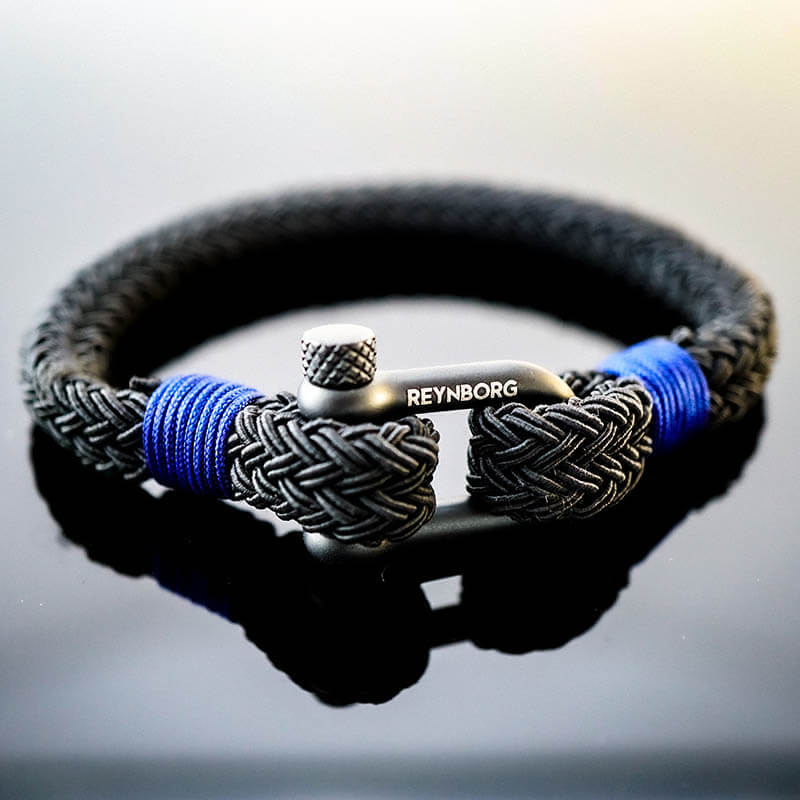
Berlin Dark-Blue is described by the shop as woven cord, with nylon identified in its product information. The photograph shows diagonal interlacing, blue wraps and a screw clasp. “Woven cord” is how the shop describes it; the photo alone can’t confirm a true warp-and-weft structure. You’d need to see how it was made to trace the strand paths.
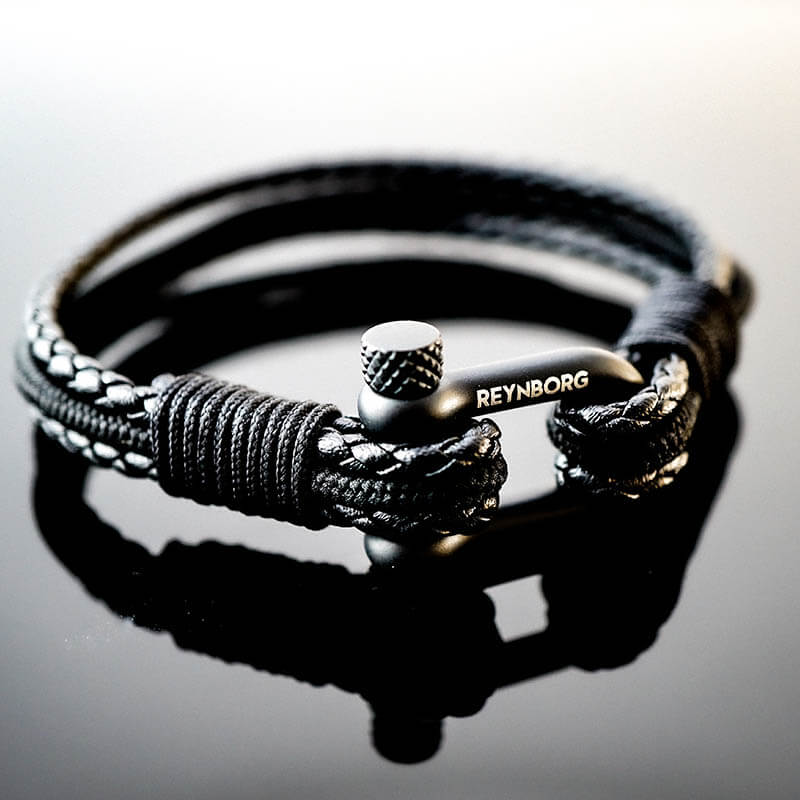
Lisbon Black combines braided leather and nylon cord according to the shop’s product record. You can see different strand textures, wrapped sections and a screw clasp. The material identification comes from that record, not color or shine. Neither photo shows hidden joints or tells you anything about material grades, strength or how long the bracelet will last.
Choose the complete bracelet, beyond the pattern
Construction names help you describe what you like, but they cannot rank strength, softness or quality on their own. Compare actual pieces for the following details:
- The surface against your wrist. Look at the underside as well as the decorative face. Decide whether the texture and any raised knots feel comfortable to you.
- The band and closure together. Check width and thickness, how the fastening sits, and whether loose tails fit your routine. A flat band can still have a bulky closure.
- The identified materials. Ask for fiber composition and any leather, coating or metal components. Interlacing does not identify those ingredients.
- The finished ends. Ask how the band is secured to the clasp or finished at the tails. A tidy outer wrap does not explain the attachment beneath it.
Operate the fastening normally if you can handle the piece; avoid pulling hard or opening the structure to investigate it. Request clear front, underside and end views when shopping online. If you want to understand the textile itself, ask which parts are woven, braided or knotted, not just whether the whole bracelet is “woven.”
Use the maker’s care instructions for the assembled bracelet. A familiar braid or knot pattern is not permission to wash, swim with or heat-seal it.