
Choose a bracelet by deciding how you want it to sit alongside clothes you already enjoy wearing. If you like a small, clean detail, compare a fine chain, narrow cuff or simple cord. If you want the bracelet to be a feature, explore a broader strap, larger links or more prominent beads. Decide how much color, texture and shape you want at your wrist.
Key facts
- A bracelet can add a little brightness, a softer texture, a line of color or a substantial shape, and naming which one you want narrows the choice.
- A tightly cropped photograph can make a delicate bracelet look substantial, so check the listed width or bead diameter and an on-wrist view.
- A flat band and rounded beads can occupy similar space across the wrist while having different profiles from the side.
- No bracelet width is required for a particular wrist size, and accessories do not all have to be the same scale.
- A closed bangle needs to pass over your hand, while an opening bracelet needs to fit when fastened.
Start with an everyday outfit, not some special occasion you’re picturing. A bracelet you like with your usual knitwear, shirt or T-shirt will actually get worn. Try the suggestions below with your own clothes; a polished cuff with denim or a cord with tailoring might be the combination you enjoy.
Use the six forms as a starting picture
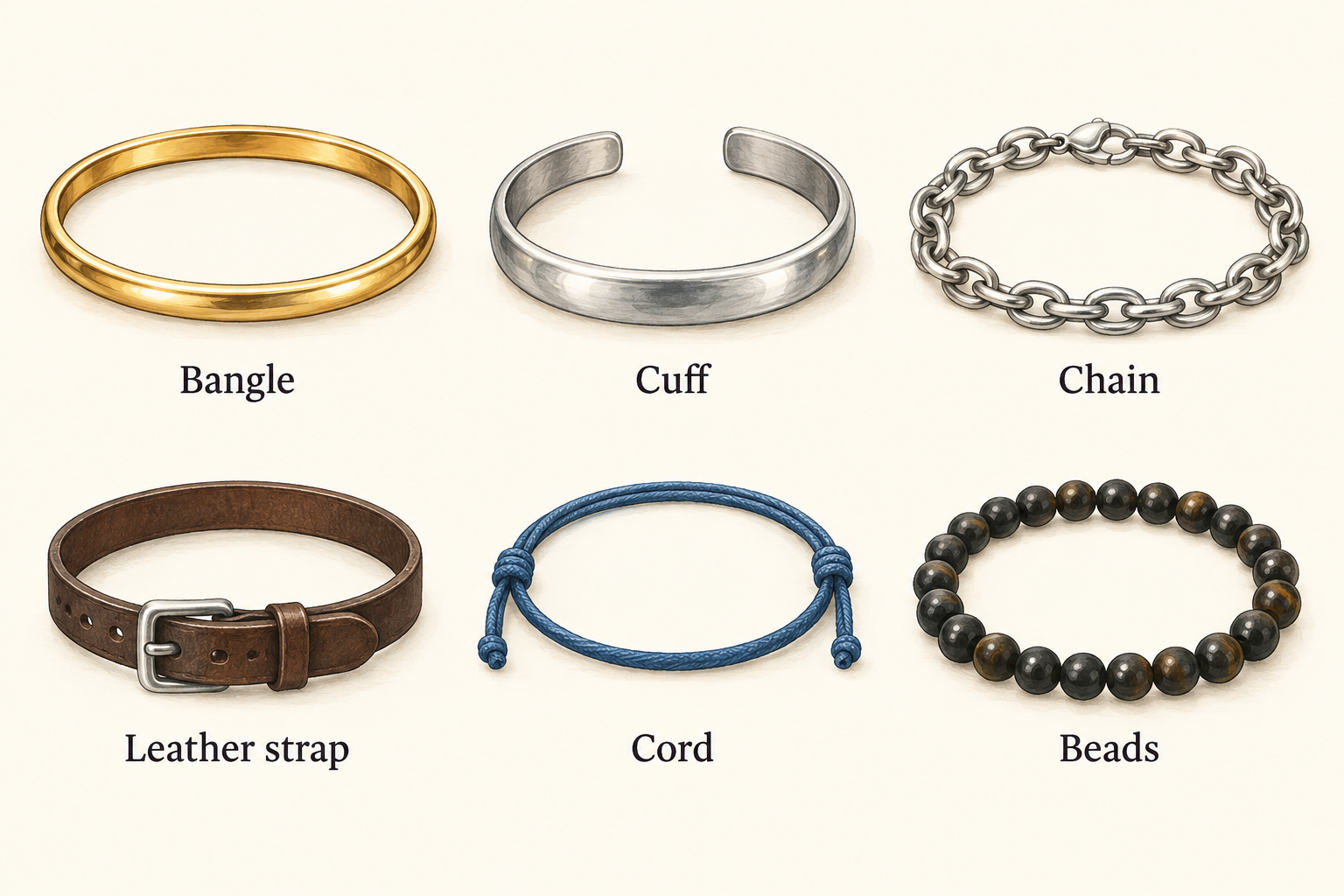
Look at the outlines first. The illustrated bangle is a closed loop, the cuff has an opening, and the chain breaks its outline into links. Below them, the leather strap gives a broad continuous band, the cord draws a thin line, and the beads repeat a rounded shape. Which outline do you find yourself returning to?
The drawing is for comparing shapes; it doesn’t show the size or fit of any real piece. A narrow strap and a wide strap can create very different impressions, as can tiny beads and large ones. For names, construction and the differences between forms, see the illustrated overview of bracelet types.
Choose what the bracelet should add
Try completing one sentence: “I want a bracelet to add…” Your answer might be a little brightness, a softer texture, a line of color or a substantial shape. That gets you further than settling on a material before you’ve seen what designs it comes in.
For a small bright detail, compare a slender polished cuff with a fine chain. The cuff offers an uninterrupted surface; the chain offers a pattern of links. Look at both against the same sleeve. You may prefer the cuff’s simple line or find the repeated links more interesting, even when the colors are similar.
For texture, try the idea of a woven cord, a visibly grained strap or a bracelet with textured beads. With a plain cotton T-shirt, that detail might be the part you enjoy most. Against a heavily patterned shirt, you might prefer a simpler surface so the bracelet feels quieter. Either choice is a preference, not a dress-code requirement.
For color, decide whether you want an echo or an accent. A dark blue cord could repeat a color in your clothes; a brighter cord could introduce something new. You do not need to match every accessory. One deliberate connection can be enough to make the choice feel considered.
For a strong shape, compare broad cuffs, wide straps and bold chains. Ask which feature attracts you: the width, the surface, the links or the closure. A large buckle can be as visually important as the strap itself. If you like the band but keep wishing the buckle were smaller, look for a different version of the same idea.
Judge scale in an outfit, not in a close-up
A tightly cropped photograph can make a delicate bracelet look substantial. Find the listed width or bead diameter, then look for an on-wrist view of that exact design. Width is only part of the picture: a flat band and rounded beads can occupy similar space across the wrist while having different profiles from the side.
Use your sleeve and existing accessories as visual reference points. If you wear a broad watch and want the bracelet to be a minor detail, consider a narrower design. If the bracelet will be your main accessory, you may enjoy a larger shape. There is no required bracelet width for a particular wrist size, and you do not have to make every accessory the same scale.
When trying one on, look in a mirror from a normal conversational distance as well as close up. Do you like the whole outfit, or only the bracelet in isolation? Then move your arm and lower your sleeve. A piece that looks right with the sleeve rolled up should also suit the way you actually wear that garment.
If your preference is consistently for a small outline and little visible detail, the minimalist bracelet buying guide explores that narrower choice, including the role of the clasp.
Three wardrobe situations to try
You wear plain layers and want one interesting detail
Imagine a gray T-shirt, dark trousers and an unpatterned jacket. You could compare a silver-colored chain with clearly visible links against a dark beaded bracelet. The chain introduces a repeated open shape; the beads introduce rounded forms. Keep the rest of the outfit the same while choosing. That makes it easier to see which pattern you prefer.
If both feel too prominent, keep the form you like and reduce its scale. Smaller links or beads may give you the detail you wanted without changing the whole idea. If both feel too quiet, try a more noticeable color before automatically adding another bracelet.
You like textured clothes and want a calmer accessory
With a ribbed sweater, denim jacket or patterned overshirt, try a plain cuff or smooth strap as a visual pause. For example, a simple dark strap beside a cream knit could give you a clear outline without adding another pattern. Alternatively, a narrow bright band could offer the small contrast you want.
You might prefer to repeat the texture instead: a braided cord with a textured overshirt can be a deliberate choice. Compare that combination with the plainer option. What matters is whether you enjoy the repetition. There’s no rule against textured jewelry with textured clothes.
You want one bracelet for several familiar outfits
Choose three outfits you really wear: perhaps a work shirt, a weekend T-shirt and a favorite sweater. Compare each candidate with all three. A slim chain, plain cuff or single cord are good places to start, but the answer is personal. Which one still looks right when the sleeve and fabric change?
You can also decide that a bracelet belongs with only one part of your wardrobe. A broad strap you love for weekends does not need to work with every shirt. Knowing its intended use can be a better reason to buy it than hoping it will suit everything.
Turn the look into a short, usable shortlist
- Pick two forms. Return to the illustration and choose the two outlines you most want to try. Leave the others aside for now.
- Name one visual priority. Write “narrow and bright,” “dark with texture” or “broad and simple,” for example. Use that phrase to compare listings instead of collecting unrelated favorites.
- Compare complete designs. Include the clasp, knots, ends and any logo in your judgment. Look for views of the whole bracelet, not just its most attractive section.
- Try your ordinary routine. If you can handle the piece, fasten it yourself, move your wrist and put your sleeve back down. Choose the design you enjoy using as well as seeing.
Once you have a favorite, check its opening and sizing method. A closed bangle needs to pass over your hand; an opening bracelet needs to fit when fastened. Follow the sizing instructions for that design; a size label from another bracelet won’t necessarily carry over.
For an online order, the guide to buying a bracelet online in the right size takes you through that final check. Also read the product’s care instructions and return conditions before ordering, especially if your choice depends on wearing it daily or trying two sizes.
Your shortlist note might read: “A narrow, dark cord for my plain shirts; a small knot; easy for me to fasten.” That gives you something concrete to shop for. Keep the bracelet buying guides handy when you move from a look you like to the details of one bracelet.