
There are six main bracelet forms: rigid bangles, open cuffs, linked chains, flexible straps, cords and beads. To tell which one you’re looking at, follow the part that goes around the wrist. It might be a shaped band, a run of moving links, a strip, a cord or a row of beads. Then look at how it opens.
Key facts
- A bangle keeps its shape. Some bangles open on a hinge, and the jewelry trade still calls them bangles.
- The familiar cuff is usually C-shaped and goes onto the wrist through an opening.
- Strap describes a strip-shaped form while leather names a material, and a wrap bracelet circles the wrist more than once.
- A tennis bracelet usually means a row of individually set diamonds or gemstones.
- A beaded loop doesn’t necessarily stretch, so check what holds the beads together and whether there’s a clasp or an adjustable section.
The illustration below shows six starting shapes. Plenty of bracelets mix them, so one piece can fairly go by more than one name. If you want help picking a look that suits your clothes, the visual guide to choosing a bracelet style picks up from here.
Six forms, shown together
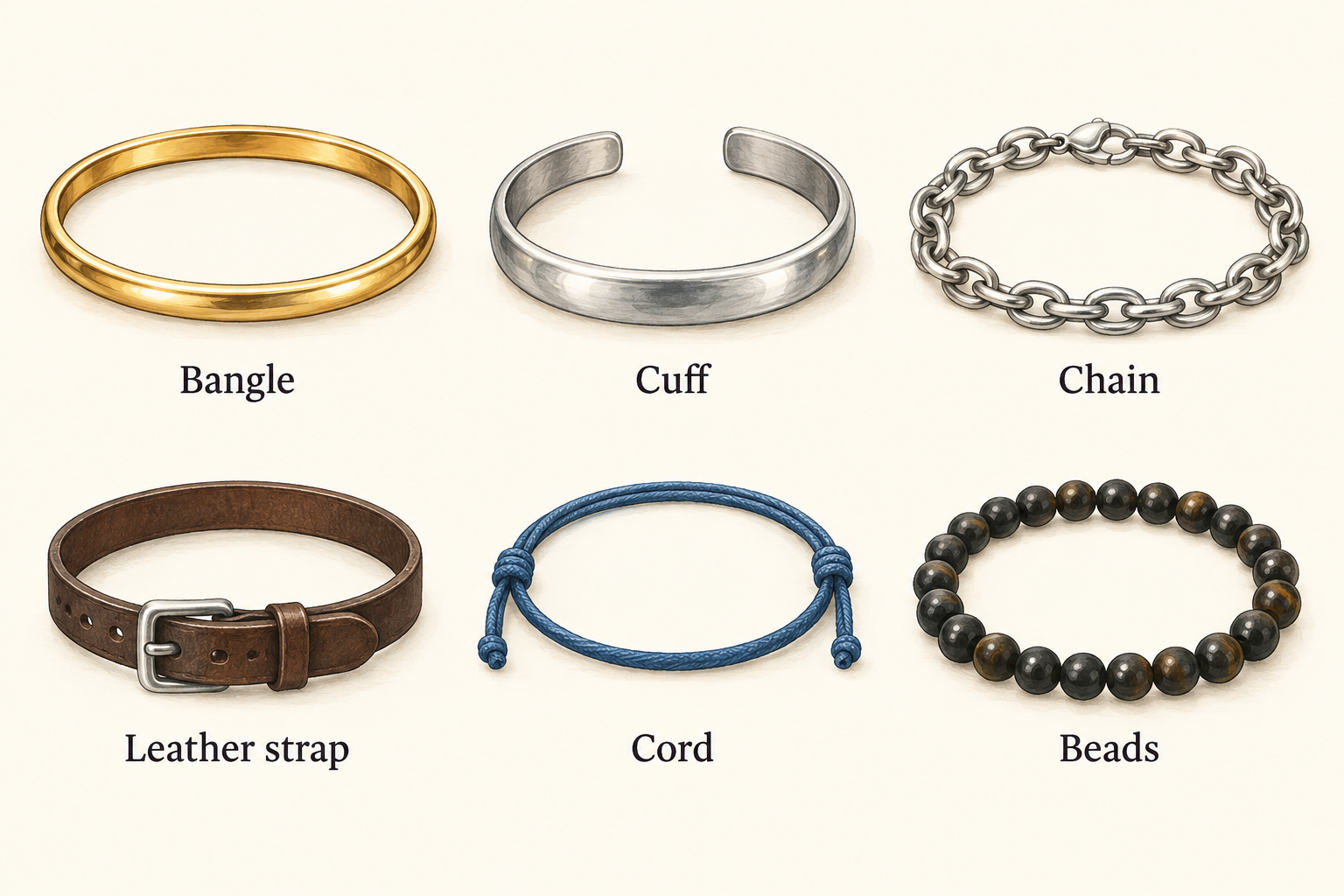
Read across the top for a closed band, an open band and linked loops. Below them are a buckled strap, a cord with visible knots, and a row of beads. These are simple outlines. Use them to recognize the forms, then check how a real bracelet is built and how it opens.
Bangle: a rigid shape around the wrist
A bangle holds its shape instead of draping like a chain. The closed one in the drawing has no opening, so it has to slide over the hand. Other bangles open, and the Jewelers of America bracelet guide still counts them as bangles. A hinge doesn’t stop a rigid bracelet being a bangle.
Look at the band and its opening separately. If you can trace one unbroken loop with no release, it has to go over your hand, and that’s the size to check. If there’s a hinge and catch, find both before you try it on. The word “bangle” won’t tell you which kind you have.
Check the inside shape too. A round bangle and an oval one sit differently on the wrist, even though both are bangles. The bangle guide covers the sizing and opening questions in more detail.
Cuff: an open band with two ends
The cuff in the drawing has a gap between its ends. Jewelers of America describes the usual cuff as C-shaped, going onto the wrist through that opening. The gap is what sets it apart from the closed bangle next to it.
Follow the band to both tips. Are they separate, overlapping or joined by another fitting? A cuff that looks open from above can hide a connector underneath, so check a view of the underside if you can’t tell.
The gap isn’t an invitation to bend the bracelet open. Find out how that piece is meant to go on. Width doesn’t decide the name either: a broad cuff is easy to spot, but a narrow open band is a cuff too. Our cuff reference goes into more detail.
Chain: connected parts that make a moving band
In the drawing, each oval loop passes through the next. Those repeated connections make up the bracelet, and the clasp joins the two ends. Jewelers of America notes that ordinary chain bracelets are flexible.
Chain patterns change the arrangement of those parts. Curb, Figaro, box, rope and other names describe different link patterns. None of them tells you the metal or the clasp. For their recognition clues, open the chain bracelet pattern reference.
Check how it moves, not only how it looks. The bracelet design in patent WO2020178806A1 uses rigid curved sections shaped to look like flexible links, with a hinge so it can open. A chain-like surface doesn’t prove a bracelet drapes. Seeing the real piece move tells you more than its name.
Strap: a strip that forms the band
The drawing’s leather strap has a broad, continuous strip and a buckle. “Strap” describes the strip-shaped form; leather names its material. Collins’ strap entry includes bands of leather and other flexible materials, so the word is not limited to leather.
Look at the whole band, underside and edges included. Is it one strip, several parallel strips or a band with a separate lining? Is the buckle really how it opens? The buckle in the drawing is just one option; strap bracelets can close in other ways.
“Leather bracelet” covers more than a leather strap. It could be round leather cord, a braid or several joined strands. “Wrap” only tells you the bracelet goes around the wrist more than once, not what it’s made of. The leather wrap guide covers that style.
Cord: a strand forms the bracelet’s body
The illustrated cord is a thin loop with visible knots. Cord is itself a built-up strand: NIST’s cord lexicon entry describes it as formed from filaments, strands or yarns. That describes the cord, not the whole bracelet.
Look at the strand, the way it goes around the wrist and the closure one at a time. A knot might be decoration, or it might be the part that adjusts the size. If you need to know whether the loop opens fully, ask to see it opened instead of guessing from the knot.
“Cord” doesn’t name the fiber either, so look for the material in the description, including any decorative sections. For single cords, thicker rope-like bands and the ways they fasten, see the cord and rope bracelet guide.
For a sailing-inspired fitting, the nautical rope entry shows how to tell the band apart from an anchor, hook or shackle-shaped clasp. For a flat textile strip, the woven bracelet entry covers what to check on the back, the edges and the end fittings.
Beaded: separate beads define the band
The drawing shows round beads on a loop. The colors are only illustrative and don’t stand for particular stones. On a real bracelet, look up the bead material first, then check what the beads are strung on and how the loop opens.
A bracelet can be beaded and corded at once. Bracelet with knots and barrel beads, in the Met’s collection, has gold beads spaced along linen cord. That doesn’t make “beaded” and “cord” two names for the same thing.
Don’t assume a beaded loop stretches. Find out what runs through the beads and whether there’s a clasp, an adjustable section or just a closed loop. Our beaded bracelet guide goes further.
Why several names can describe one bracelet
One bracelet can carry several names at once. Take “beaded cord wrap bracelet with a button closure.” Beaded is what you see, cord is the strand underneath, wrap is how it goes around the wrist, and button closure is the fastening. None of those words gives you the bead material or the size.
If you’re trying to find an unfamiliar piece, the bracelet naming guide turns those layers into a search phrase. If you’re deciding which look to try, the written style quiz is a better place to start than a construction name.
Some names point to a feature or a purpose instead. An ID plate can sit in a chain or another band. “Tennis bracelet” usually means a row of individually set diamonds or gemstones, as the Jewelers of America guide notes. A friendship bracelet is named for the friendship behind it, so the name tells you nothing about how it’s made.
Keep the clasp separate from the main form. A box chain and a box clasp are different parts, and a cord bracelet can still have metal hardware. Once you’ve named the band, the photographic clasp reference helps you work out how it opens.
For more specific entries, browse the bracelet types reference.
Once you can name the form, the type-and-material shopping guide shows how to compare a few complete designs.