
Laser engraving removes material to make a recess. Other laser marks can change a metal’s color, remove a coating or use an added marking compound. On a bracelet, those differences matter more than whether the order form calls the result “engraved,” “marked” or “etched.”
Key facts
- Recessed laser engraving removes metal to form the inscription, while heat-based color marking, often called annealing, changes the surface color without cutting a recess.
- A laser can also strip a coating in selected areas, which doesn’t mean the letters are cut deep into the metal underneath.
- Color tells you nothing about depth. A dark laser mark can be completely smooth.
- “Laser etching” is a loose term, so ask whether the process removes metal, changes its color or strips a coating.
- A digital proof can show spelling, spacing and placement, but it cannot show the reflection, texture or color of the completed mark.
Start with the effect you want: lettering you can feel, a smooth dark inscription, or a contrasting design revealed through a colored finish. Then compare a finished example on the same material and surface. A close-up of black lettering alone cannot tell you which process produced it. For the wider choice between cut, scored, pressed and printed marks, use the engraving techniques comparison.
What actually changes at the surface?
Trotec’s metal-marking explanation separates material removal, heat-based color marking and coating removal. It helps to keep those three apart when you compare personalization services.
| Finished effect | Details to compare |
|---|---|
| Recessed laser engraving | Change: Metal is removed to form the inscription. For your bracelet: The line’s appearance and feel, including its edges. |
| Heat-based color marking, often called annealing | Change: Heat changes the surface color without cutting a recess. For your bracelet: Contrast against the chosen finish and the care instructions. |
| A design revealed through a coating | Change: The laser removes the surface layer in selected areas. For your bracelet: Which layer is exposed and what color it will be. |
| Compound-assisted marking | Change: An applied marking material is bonded through laser processing. For your bracelet: What remains on the surface and how it should be cared for. |
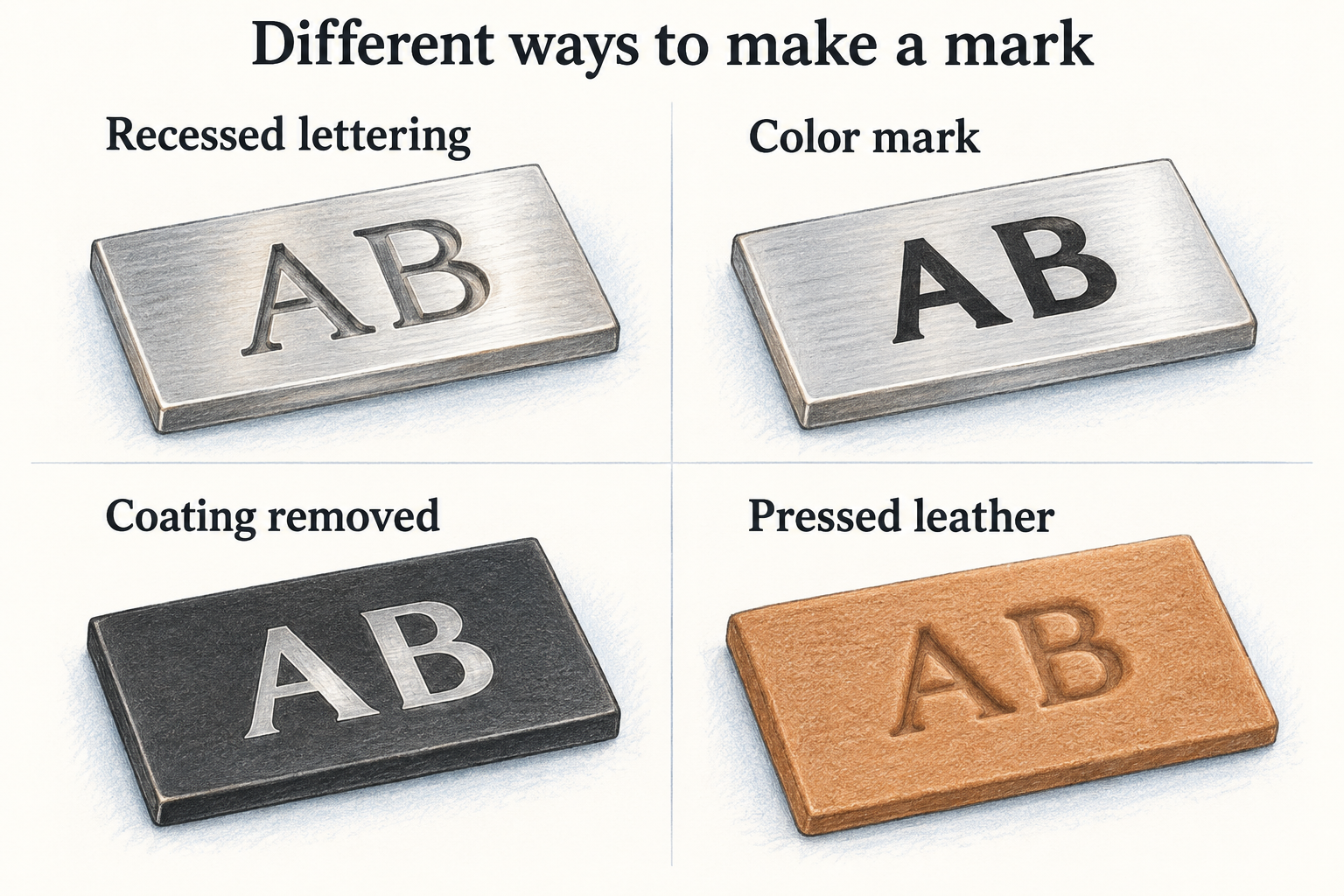
Stripping a coating doesn’t cut a deep inscription into the metal beneath it. If you want a pale message on a dark clasp, that contrast may be the intended design. If you want the clasp to remain dark throughout the lettering, the same process would be the wrong choice. The guide to black stainless-steel finishes explains why the coating and the metal under it need describing separately.
Black lettering does not tell you how deep it is
A dark mark can be smooth. In its annealing guidance, Trotec describes heat-based color change with no material removed. So a photo of black lettering can’t tell you whether it’s a cut groove.
Added color is another possibility. Gravotech’s engraving filler documentation, for example, describes paint used to add contrast to mechanical engravings. So a colored recess may get its color from added paint, not from the engraving itself.
Printing is different again. Roland DG explains that UV printing deposits and cures ink; layered printing can also create texture. Raised or colorful lettering doesn’t, on its own, show that the metal was cut or embossed.
On a bracelet, describe the inscription and any added finish separately. “Cut lettering with black fill” tells you more than “black engraving.” Neither tells you whether the finished piece suits daily skin contact or how long the contrast will last.
What does “laser etching” mean?
It’s a loose label, not a specification. Ask the provider: “Does this remove metal, change its color or remove the coating?” There’s no agreed depth that separates etching from engraving, so don’t pick a service on that basis.
The word also appears outside laser work. Cougartron’s electrochemical-process explanation distinguishes a dark surface mark from etching that removes material. That’s about electrochemical marking, and it doesn’t define every service sold as “laser etching.”
Ask the provider to describe the result on your bracelet and show a comparable example.
Does laser marking affect stainless steel’s corrosion resistance?
It depends on the process. Trotec’s annealing guidance notes possible corrosion effects under some processing conditions. So don’t assume a laser-marked bracelet is immune to corrosion, and don’t assume every laser mark damages the steel either.
A 2024 study of laser-treated 316L stainless steel found improved corrosion performance for its specifically prepared and treated specimens compared with untreated specimens in controlled salt-solution testing. The research concerned surgical-device materials, not bracelets worn against the skin. It’s a reason to take processing conditions seriously, but it says nothing about how long an engraved clasp will last or how to care for it.
For your order, what counts is the actual metal, the marking process and the finished surface. Keep the care instructions with the bracelet. If it’s polished or has scratches removed later, show the inscription to the person doing the work first; the steel-bracelet scratch guide covers that decision. If the letters already look faded, engraving wear and restoration helps describe what has changed.
How to read a sample before committing
A sample should help you picture the finished bracelet as you’ll wear it. An enlarged photo of lettering on a flat industrial plate may explain a process, but it won’t show you much about a curved clasp or a narrow jewelry plate.
- Match the surface. Look for the same named metal and finish. A sample on bare polished steel leaves questions unanswered about a coated bracelet.
- See it at wearing size. Look at the whole piece as well as the close-up, and judge the contrast and size of the letters without zooming in on a screen.
- Separate the layout from the finish. A digital proof can show spelling, spacing and placement. It can’t show the shine, texture or color of the finished mark.
- Ask about added materials. If the lettering includes filler or printing, the care instructions should cover that too.
For example, imagine two services offering the same initials on a steel bracelet: one shows smooth dark lettering; the other shows recessed lines. Which is better depends on whether you want strong contrast, a cut inscription or a particular feel. The word “laser” doesn’t make either one better.
If you’re still deciding whether your bracelet’s plate, clasp or inner surface is the right place, start with what can be engraved on a bracelet. For lettering ideas and other ways to carry a message, see the personalized bracelet guides.