
For lettering that feels part of a leather bracelet, compare marking the leather itself with a pressed impression. For a colored design, look at printing or a foil finish. For words on a smooth, separate surface, choose an inscribed metal plate or clasp. These can all be sold as personalization, but they give you different things to see and touch.
Key facts
- Embossing forms a raised relief by pressing the leather, while debossed commonly describes lettering pressed below the surrounding surface.
- Printing adds ink without cutting the strap, and layered ink can create texture, so raised lettering doesn’t prove the leather was pressed.
- Vegetable-tanned leather is still animal leather, and neither that label nor full-grain tells you what finish was applied.
- Laser equipment guidance rules out PVC and leather containing chromium(VI), because lasering them can release hazardous fumes.
- A separate metal plate keeps the inscription off the leather, but that doesn’t mean you can remove it or move it to another strap.
Start with the effect you want, then compare finished examples on the actual material. A process name won’t show you how clearly a small date will read on a dark, textured strap. For choosing the message itself, see the personalized bracelet guides.
Where will the words actually be?
| Option | Details to compare |
|---|---|
| Laser engraving or marking | Lettering: A change to the leather or its surface finish Compare: Contrast, texture and whether the result has a recess |
| Pressed lettering | Lettering: An impression or relief formed in the leather Compare: Whether letters are recessed or raised, and how they look in ordinary light |
| Printing | Lettering: Added ink on the surface Compare: Color, surface feel and care for the printed finish |
| Inscribed plate, tag or clasp | Lettering: A separate metal component Compare: Letter size, position, edges and how the fitting sits on the wrist |
Marking the leather surface
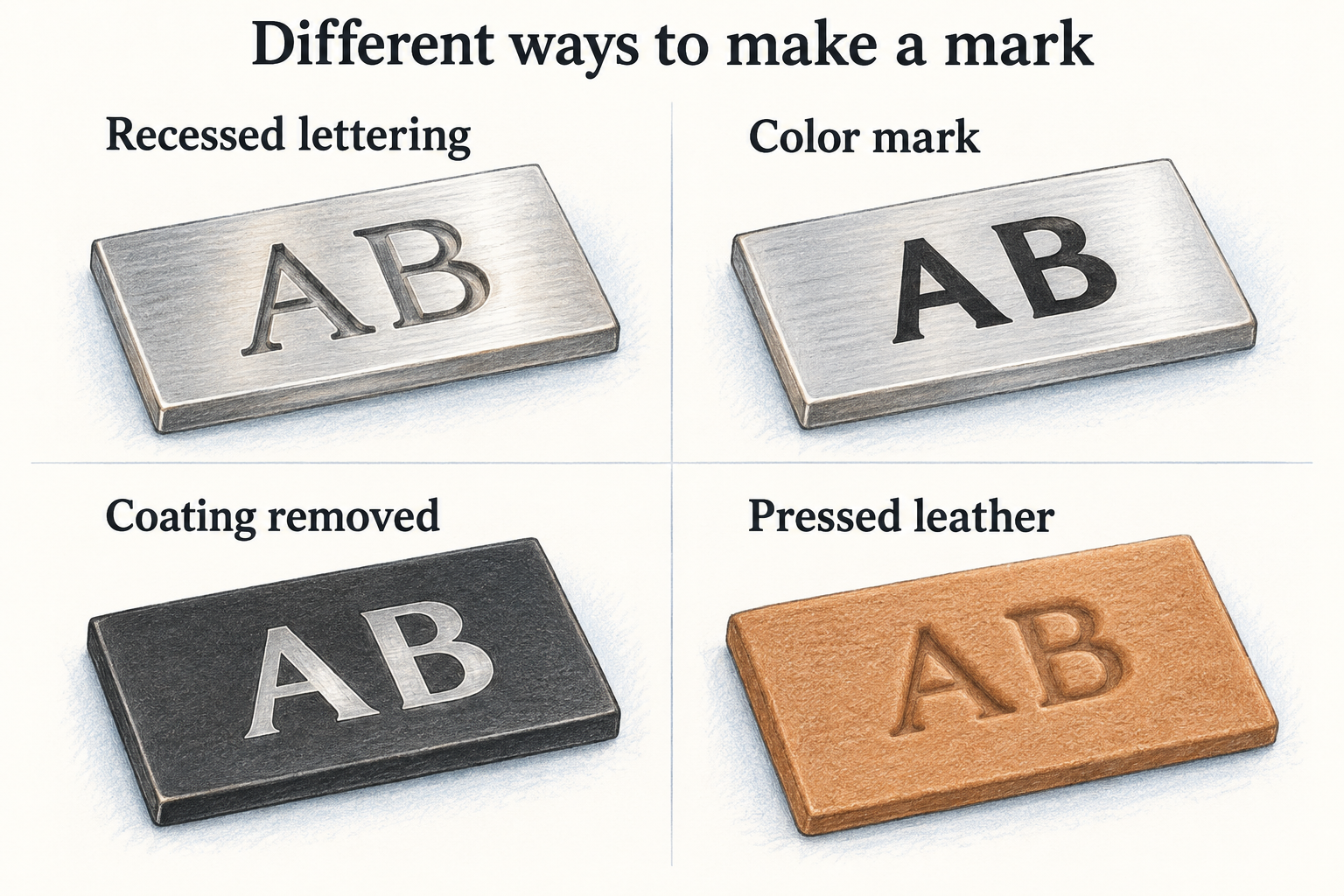
A laser can produce lettering by changing the surface color or removing material. Trotec’s process explanation describes both heat-related contrast and material removal. Ask which of these the service will produce on your strap: a dark mark, a recess or a change to a surface layer.
This suits you if you want the lettering to be part of the leather, not on a metal panel. Look closely at a finished example in a similar color and grain. Check that the message still reads without dramatic lighting or a tight crop, and that fine strokes don’t vanish into the texture. A short inscription with simpler lettering may suit the available space better than a detailed emblem.
Don’t pick a process from the tanning label alone. Vegetable-tanned leather is still animal leather, and neither that label nor “full-grain” tells you what finish was applied. Tanning, grain and finish are separate parts of a bracelet’s specification.
Pressed lettering: embossing and debossing
Pressure forms the design instead of tracing it with a laser. Horween’s leather glossary defines embossing as forming a relief pattern or texture by pressing leather. In personalization listings, you may see “embossed” used broadly; “debossed” commonly describes lettering pressed below the surrounding surface. Go by the finished result, not by either word.
A recessed initial without added color is a quiet choice. You notice its shape and shadows, not a contrasting graphic. If you want something more visible, a service may offer a foil-colored impression. Check whether the color is an added foil, because that’s one more material to look after.
A photograph taken at an angle helps show the shape of an impression. A straight-on view helps you judge how visible it will be when worn. Both views are more useful than a digital name preview that shows only placement and font.
Printed words and color designs
Printing adds ink; nothing is cut into the strap. UV printing, for example, applies ink and cures it with ultraviolet light; Roland DG’s technical overview also explains how layered ink can create a tactile effect. So raised lettering on its own doesn’t mean the leather was pressed.
Consider printing when color is central to the idea, such as two colored initials or a small graphic. Check a sample of the offered printing process on the same finished material, along with its bracelet-specific care instructions. A description of the printing equipment won’t tell you how that ink will stick, flex or wear on your strap.
A metal plate keeps the inscription off the leather
A separate plate can be the clearest choice if you want a defined writing panel. It also lets you keep the leather undecorated. The metal’s finish and inscription process still matter: a cut line, a dark surface mark and exposed metal beneath a coating will look different. See which bracelet parts can be engraved for those choices.
Think about the fitting as something you will wear, too. A front plate, an underslung tag and an inscribed clasp put the message in different places. Check its position on the wrist, the feel of its edges and whether it moves or turns. A photo of the complete bracelet helps more than a close-up of the words alone.
A separate fitting isn’t necessarily removable or something you can move to another strap; it has to be attached in a way that suits that bracelet. The same goes for cord, textile and beaded designs, where a plate or charm can carry the message without marking the cord or fibers.
Material information matters before laser work
The engraver needs to know exactly what the strap is made of, including any surface coating and any backing, lining or adhesive. Not every leather bracelet has those extra layers. “Vegan,” “PU” and “faux leather” don’t say much either; the guide to leather alternatives explains the possible constructions.
Trotec excludes PVC and leather or artificial leather containing chromium(VI) from laser processing because lasering them can release hazardous fumes. That doesn’t mean all chrome-tanned leather contains chromium(VI): Leather Naturally identifies chromium(III) as the chrome-tanning agent. A vegetable-tanned or PU label doesn’t make a strap suitable for the laser either. Let the engraver decide from the material details, and if they can’t confirm it, choose a different way to add the words.
Choose the sample, then the wording
Imagine the same initials on a brown strap: a low-contrast impression makes them discreet, a surface mark makes their contrast part of the leather, colored print adds a graphic detail, and a metal plate gives them a separate frame. Pick the one whose appearance you would enjoy even before you read the initials.
Settle the wording on an actual-size layout and the finish on an approved sample. Ask how to clean the finished bracelet, including any ink, foil or metal fitting. A good order names both the message and the result, for example “these initials, recessed without added color, on this strap surface.” For a metal fitting, the engraving techniques comparison helps choose the mark separately from the leather.